
.jpeg)
Gallery
.jpeg)
.jpeg)
.jpeg)

History
A native of Maine, Alden Vose moved to Oklahoma City in 1912 following in the footsteps of his brother, Richard. He became treasurer of the Harriss-Irby Cotton Company, a cotton brokerage firm with headquarters in Galveston, Texas. Alden and his wife Florence purchased the lots at 400 N. W. 16th and hired James W. Hawk as their architect. Hawk had already received widespread praise for one of his homes, the Spanish Colonial Revival built for Alden’s brother at 14th and Walker.
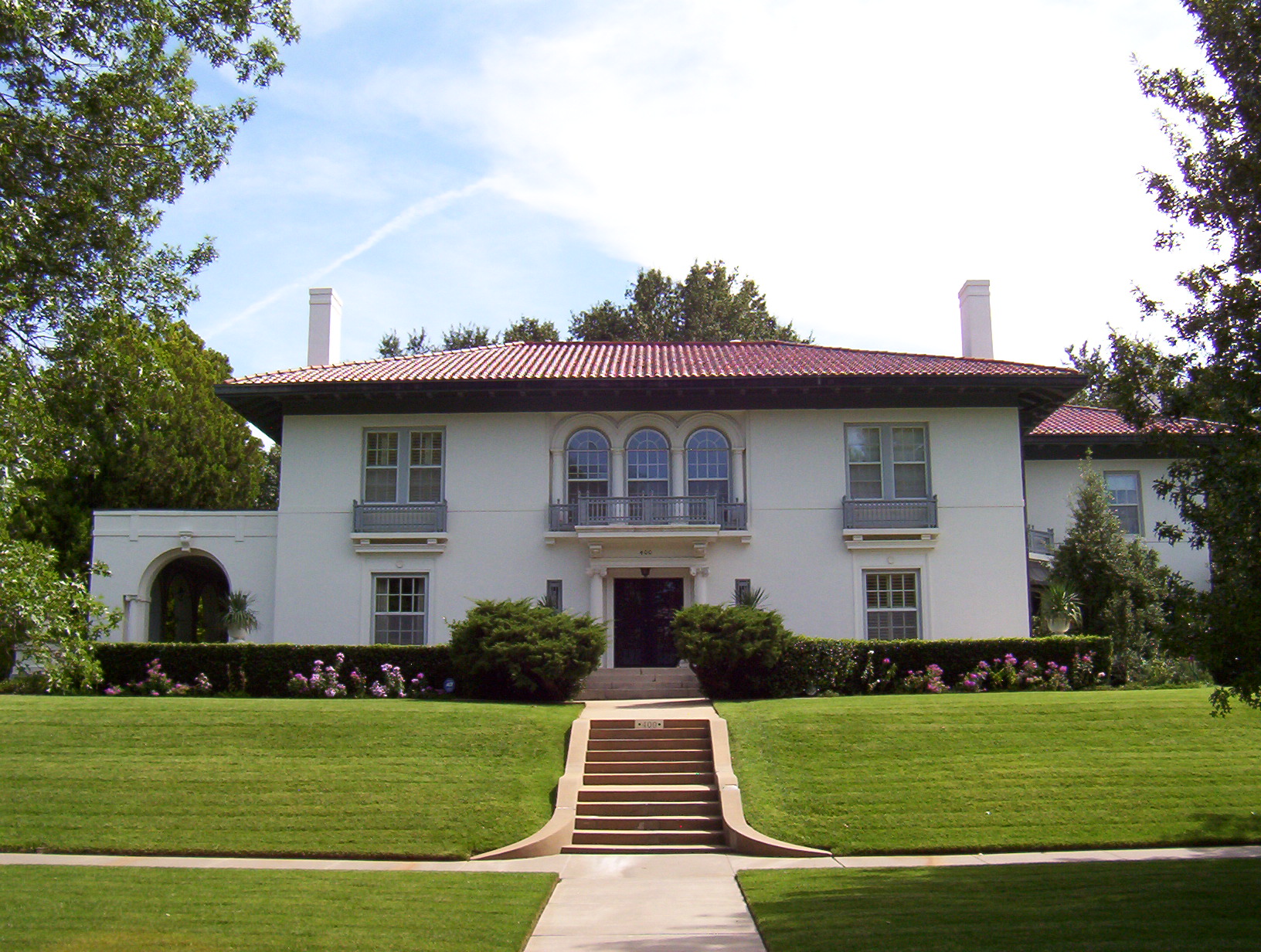
Built at a cost of $41,000, Alden's house on 16th was a two-story stucco with Mediterranean features including arched windows supported by classical columns, balconets, a red-tiled roof, and classical door surround.
Supervised by 15th Street neighbor Robert Gardner, construction was completed in three years. At their house warming party guests entered the festivities on a specially designed slide into the basement!
In 1920 the Aldens returned to the East Coast and sold the home to Walter R. Ramsey. Walter, born in 1885, was a native of Texas and grew up in Ardmore, Chickasaw Nation. After attending business school, he entered the banking business and moved to Oklahoma City, where he turned to the budding oil industry and struck it big in the Healdton Field. By 1920, when he purchased the home on 16th, Ramsey was one of the region's top Oilmen.
The Ramseys made the home a center for parties and social events. They built a large tennis court on the westernmost lot - only to replace it a few years later with one of the city's first and largest private swimming pools.
They also divided the large basement into two rooms - one for one son's model trains, and the other for another son's small movie theater where they could watch silent movies before they were released in the movie houses.
Walter remained in the home until his death in 1947 at the age of 61. He had suffered a cerebral hemorrhage while on vacation in California.
In 1948, the house was purchased by colorful political figure and entrepreneur Reuel Little and his wife Oteka. They lived in the house with their four children until 1952 when they put it up for rent.
Among the renters was a group of young professional women who dubbed the house "Poverty Palace" and made it hum again with lively parties and dances. The house was even lived in one summer by a semi-pro baseball team. Yet another interesting era began in 1957 when the Carmelite Sisters of Saint Therese bought the house and used it as a novitiate.
Dr. Joseph and Vestina Ruffin bought the home in 1965. Joe was born August 12, 1928, in Chicago, Illinois. He attended the University of Illinois and Loyola Stritch School of Medicine. His internship was in El Paso, Texas, where he met Vestina Provenciaon a blind date.
Vestina was born March 22, 1929, in Anthony, New Mexico, where she grew up on a family farm. She attended Texas Western University (UTEP), earning a Masters in Spanish. She began her career of teaching Spanish at El Paso High.
Joe and Vestina married June19, 1954. Joe’s training took them to Japan, Cincinnati, and California before a final move to Oklahoma City in 1962 to pursue residency training at the University of Oklahoma Department of Psychiatry. During these years they had six children, Joseph, Mykl, Carlos, Richard, Mark, and Lisa.
When they moved in the house in 1965 it was in poor condition after years of neglect. Like the house, the neighborhood too had suffered. The Ruffins were an integral part of the renaissance movement focused on the preservation of historic Oklahoma City homes.
The Ruffins redecorated the entire house, gutted the kitchen, and repaired damage done during the 1950sand 1960s. Over time they transformed the "Poverty Palace" into an elegant home. The basement playroom, the big hill in the front yard, and the large swimming pool were especially enjoyed by the Ruffin children and all their neighborhood friends.
The Ruffins furnished the home with American, English, and Oriental antiques and, through the years, decorated it with eclectic collections of paintings, prints, and objets d'art. Dr. Ruffin was the curator of a fabulous garden at their home which included an extensive display of Japanese maples.
Their beautiful home was on the Heritage Hills Historic Home and Garden Tour four times, beginning with the first tour in 1967.
In 2001 the home was purchased by the Ruffin's daughter, Lisa, and her husband who also grew up in Heritage Hills. They had held their outdoor wedding reception at the home in 1989.
Spacious and welcoming, the house invited multigenerational family living as they raised their four children, Joe, Adele, Charlotte, and Natalie, in the home while Lisa’s parents continued to live there. Lisa’s father died in 2012 and her mother died in2020.
The art collection and primary furnishings of Joe and Vestina’s remain in place. The current homeowners did extensive renovations to the kitchen, converting a back porch to an enclosed entry leaving intact the niche that had been used for milk delivery; renovations also include bedrooms, bathrooms, the garage apartment and pool houses with the intention of staying period to the home. The couple continues the tradition of graciously sharing their home for social and family gatherings, large and small and they also featured the home on the 2015 Home Tour.
2025 marks the 60th year that members of the same family have owned and lived in this icon of Heritage Hills. The couple are proud caretakers of this house and hope that, whether or not it stays in their family, future generations will care for it as lovingly.
Home Info
Street:
Northwest 16th Street
Block:
400 Block of NW 16th Street
Year Built:
1915
Owners:
Historic Photo:
Audio Tour:
Looking for some excitement?
Let's roam the neighborhood, explore, and connect with others.


.svg)
© 2020 Heritage Hills Walking Tour. Website Design by Center Point Designs, LLC